Looking for liver transplant in Chennai? Learn how to choose an experienced liver transplant surgeon based on expertise, transplant team, technology and care.
Hernia: Separating Myths from Medical FactsWhat Every Patient Should Know
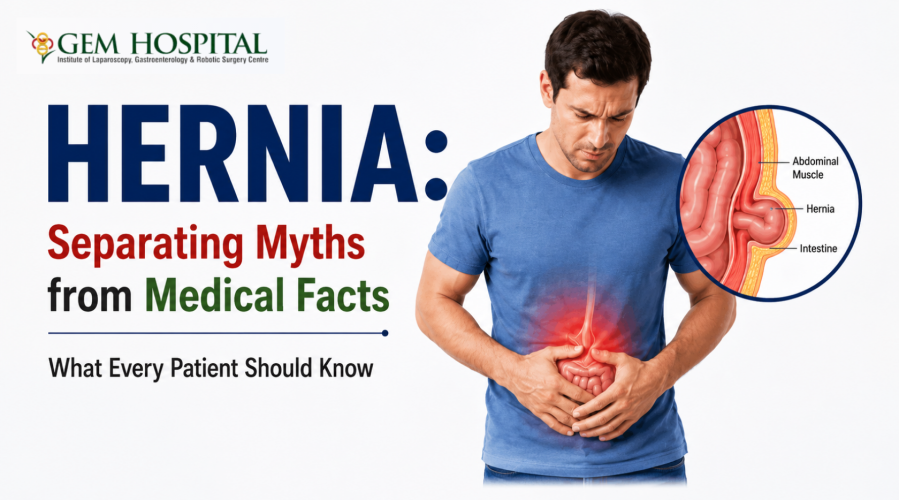
“It’s just a small bump – it’ll go away by itself.” This is one of the most common and dangerous misconceptions about hernia. The fact is, a hernia does not heal on its own. If left untreated, it can enlarge, become painful, and in some cases turn into a surgical emergency requiring immediate intervention. This is why considering timely hernia surgery in Chennai is important for proper management and long-term relief.
Despite being one of the most common digestive and abdominal conditions worldwide, many patients delay care due to misinformation or fear. Seeking expert consultation for hernia surgery in Chennai can help prevent complications and ensure safe, effective treatment.
What Is a Hernia, Anyway?
A hernia is when an organ or fatty tissue pushes through a weak spot or opening in the surrounding muscle or connective tissue. It's like a balloon pushing itself through a hole in a rubber tyre the pressure makes a bulge that can be pushed back for a while, but will keep coming back unless the hole is sealed.
The most common types are:
- Inguinal hernia. It occurs in the groin and is more common in men.
- Umbilical hernia: Near the navel, common in infants and adults.
- Hiatal hernia: The stomach bulges upward into the chest through the diaphragm.
- Incisional hernia: Occurs at the site of any previous surgical incision.
Types of hernias Femoral hernia: More common in women, near the upper thigh.

Myth #1: 'I Can Feel When It's Getting Dangerous'
One of the most persistent myths is that a hernia will always give you obvious warning signs before it becomes an emergency. Unfortunately, that's not always true.
A strangulated herniawhere the blood supply to the protruding tissue is cut offcan occur with relatively little warning and constitutes a medical emergency. Symptoms include sudden severe pain, nausea, vomiting, a bulge that cannot be pushed back in, and discolouration of the skin over the bulge. Without prompt surgical intervention, strangulation can lead to tissue death and life-threatening complications.
Myth #2: ‘This Only Happens When You Lift Heavy Things’
Heavy lifting is a well-known risk factor, but it's not the only one. A hernia can be caused by chronic coughing, straining when having a bowel movement (often associated with constipation), obesity, pregnancy, previous abdominal surgery, or simply ageing. Muscles naturally weaken over time.
Indeed, some people are born with a congenital weakness of the muscles predisposition. Other factors that impact overall gastrointestinal health such as chronic constipation and abdominal pain – also have a role in increasing intra-abdominal pressure that can lead to hernia formation.
Myth #3: Surgery is too dangerous. I’ll just wear a belt.
Trusses and support garments can give temporary relief but do not correct the underlying problem. A hernia doesn’t go away by itself. The opening usually gets bigger over time and the tissue that protrudes enlarges , making surgery later on more complex .
The use of laparoscopic surgery to repair hernias has dramatically altered the treatment landscape today. Now surgeons can repair a hernia with minimal trauma to surrounding tissue, through small incisions using a camera-based technique. Patients usually experience much less post-operative pain, less scarring, shorter hospital stays and a quicker return to daily life than traditional open surgery. This is one of the most celebrated applications of minimally invasive surgery in contemporary medicine.
When to Have Surgery?
When to have hernia repair depends on a number of factors. These include the type and size of the hernia, your symptoms, your overall health, and your risk of complications. For symptomatic hernias, which are those that cause pain, discomfort or limit activity, surgical repair is generally advised sooner rather than later.
In otherwise healthy adults, asymptomatic hernias can be observed over time, but this requires regular follow-up and patient awareness of warning signs. Your surgeon will consider the risks and benefits and discuss the best timing for your particular circumstances. Here it’s all about personalized care for patients.
A hernia is not something to take lightly, nor is it something to fear. With accurate information and timely care, the vast majority of patients recover fully and return to active, unrestricted lives. Hernia Repair and General Abdominal Health
It should be understood that hernia repair is closely linked to the overall condition of the abdomen and digestive system. Patients with gallstones, kidney stones, or those recovering from liver transplants may have a surgical history that increases the risk of developing incisional hernias. This is why a comprehensive evaluation is essential before planning hernia surgery in Chennai.
“We have a multidisciplinary surgical team to address all concerns in a holistic way,” ensuring that every patient receives personalized care and the most effective hernia surgery in Chennai based on their condition.
Book a consultation with GEM Hospital’s today.