

Hernia Surgery in Chennai
Advanced Hernia Surgery in Chennai at GEM Hospital
Hernia surgery is one of the most frequently performed and refined procedures at GEM Hospital. When abdominal muscles weaken, internal tissues or fat can push through, creating a noticeable bulge and causing discomfort or pain. Because hernias do not heal on their own, surgery is the definitive solution to prevent complications like bowel entrapment or strangulation.
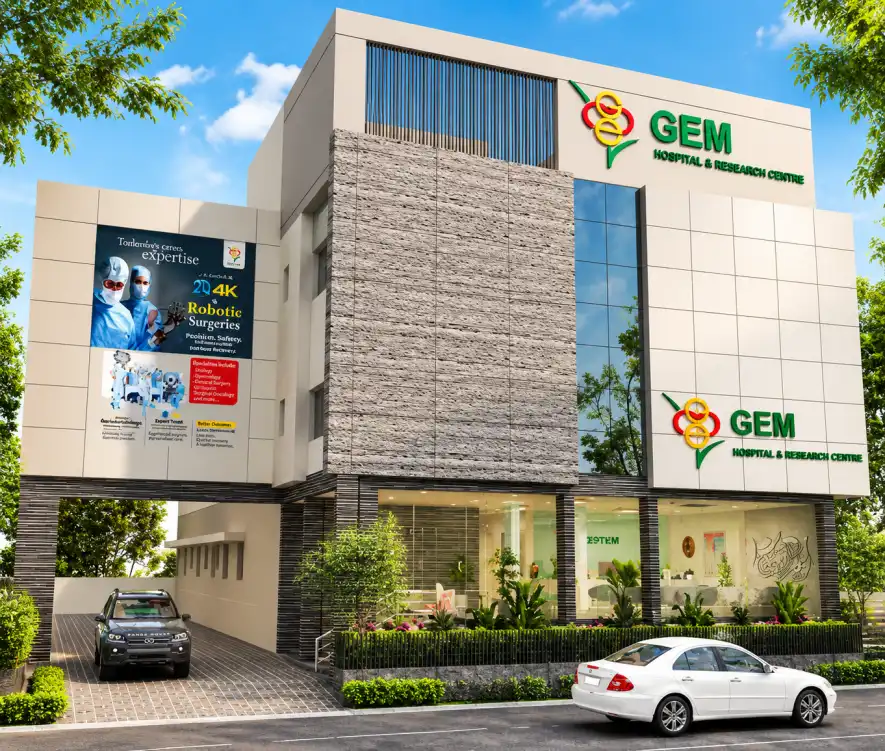
At our Chennai centers (Aminjikarai and Perungudi), our surgical team utilizes state-of-the-art laparoscopic and robotic hernia repair techniques. This ensures smaller incisions, negligible blood loss, minimal post-surgical discomfort, and a rapid return to work and active life.
Care Highlights at GEM Hospital Chennai

Surgical Approaches to Hernia Repair
Hernia surgery involves returning the protruding tissue or organ into its normal anatomical position and reinforcing the weakened abdominal wall with surgical mesh. At GEM Hospital Chennai, our surgeons specialize in minimally invasive techniques that minimize tissue trauma and promote accelerated recovery.
Laparoscopic Hernia Surgery (Keyhole Repair)
Performed through 3 tiny keyhole incisions (5mm to 10mm) using a high-definition 4K camera. The surgeon repairs the defect from the inside and places an anatomical mesh. Benefits include substantially less post-operative pain, minimal scarring, lower infection risk, and same-day or 24-hour discharge.
Robotic-Assisted Hernia Repair
Utilizes advanced robotic instrumentation with 3D high-magnification visualization and articulated wristed tools. Ideal for complex, recurrent, or large incisional hernias requiring meticulous abdominal wall reconstruction (Component Separation Technique - TAR/CST).
Open Hernia Surgery
Recommended for patients who cannot undergo general anesthesia, or who have exceptionally large, non-reducible, or strangulated hernias. A single direct incision is made over the hernia site, tissues are repositioned, and tension-free mesh is secured.
Types of Hernias We Surgically Repair
Our Chennai surgical team treats the entire spectrum of primary and complex recurrent hernias:
Inguinal & Femoral Hernias
Groin hernias (direct and indirect) repaired via TEP (Totally Extraperitoneal) or TAPP (Transabdominal Preperitoneal) laparoscopic procedures.
Umbilical & Paraumbilical
Defects located at or adjacent to the navel, frequently treated with minimally invasive intraperitoneal onlay mesh (IPOM) placement.
Incisional & Ventral Hernias
Hernias developing along surgical scars from previous abdominal operations, reconstructed with advanced tension-free mesh techniques.
Hiatal / Diaphragmatic Hernias
Stomach protruding into the chest cavity causing severe GERD; treated with laparoscopic fundoplication and hiatal crural repair.
Hernia Surgery Recovery Timeline
Laparoscopic hernia surgery significantly reduces down-time compared to traditional open surgery. Here is what patients can expect:
Days 1 - 2: Immediate Post-Op & Walking
Patients are mobilized within a few hours of laparoscopic repair. Most patients are discharged either the same evening or the next morning with mild oral painkillers.
Week 1 - 2: Resuming Routine Activities
Normal household activities, desk work, and driving can typically be resumed. Incisions are healed and post-operative review confirms smooth wound recovery.
Weeks 4 - 6: Full Physical Activity & Exercise
Tissue incorporation into the surgical mesh is complete. Patients can safely resume gym workouts, heavy lifting, sports, and vigorous physical exertion.
Why Choose GEM Hospital for Hernia Surgery in Chennai?
Founded by visionary laparoscopic pioneer Prof. Dr. C. Palanivelu, GEM Hospital is internationally recognized as a premier center of excellence for hernia and abdominal wall surgery:
Over 35,000+ Surgeries
Unmatched clinical experience handling routine to the most complex recurrent abdominal wall hernias.
Ultra-Low Recurrence Rate
Tension-free mesh placement and anatomical precision yield industry-leading success rates exceeding 99%.
Advanced 4K & Robotic Suites
Equipped with ultra-high definition laparoscopic towers and robotic surgery systems at Aminjikarai & Perungudi.
Daycare Surgery Pathways
Smooth admission, minimally invasive surgery, and prompt discharge protocol with comprehensive home-care follow-up.
Frequently Asked Questions
Laparoscopic hernia repair is widely considered the best treatment option, offering minimal scarring, less post-operative pain, and faster recovery compared to open surgery. GEM Hospital in Chennai offers both laparoscopic and open techniques based on the patient's condition.
Hernia surgery is a safe and routine procedure, not typically classified as major surgery. Most patients recover within 1-2 weeks with laparoscopic repair, and the procedure has a high success rate when performed by experienced surgeons.
Hernia surgery costs in Chennai vary depending on the type of hernia, surgical technique (laparoscopic vs open), and hospital stay duration. Contact GEM Hospital directly for a personalized cost estimate and insurance cashless guidance.
Recovery from laparoscopic hernia surgery typically takes 1-2 weeks for light activities, while open surgery may require 3-4 weeks. Full recovery, including resuming heavy lifting or strenuous exercise, usually takes 4-6 weeks.
Common symptoms include a visible bulge in the abdomen or groin, pain or discomfort that worsens with lifting or straining, and a feeling of pressure. If the bulge becomes painful, red, or firm, seek immediate medical attention as it may indicate a strangulated hernia.
Hernias do not heal on their own and typically require surgical repair, as the weakened muscle wall will not close without intervention. Delaying treatment can increase the risk of complications like incarceration or strangulation.
Living With a Hernia? Get Expert Surgical Advice in Chennai.
Don't let a hernia compromise your comfort or risk serious complications. Consult GEM Hospital's expert laparoscopic surgeons today.