
Learn about gallbladder stone symptoms, diagnosis, treatment options, surgery and recovery at GEM Hospital, Chennai.
Struggling with Urological Issues? Find Relief with Urology Treatment in Chennai
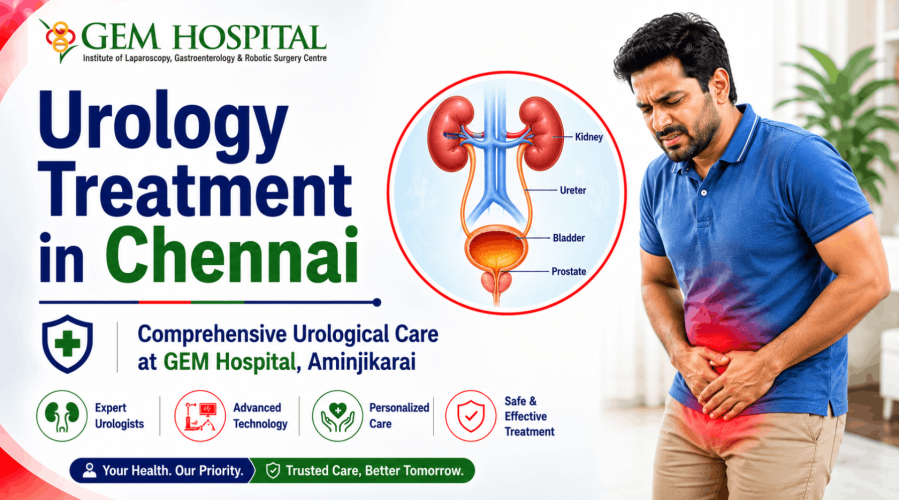
There are certain medical problems people speak about freely and then there are the ones they suffer through quietly for months, or even years, out of embarrassment, hesitation, or the hope that things will resolve on their own. Urinary problems belong firmly in the second category. Whether it is a burning sensation during urination, blood in the urine, difficulty emptying the bladder, or something more complex like prostate enlargement or urological cancer, these conditions deserve expert attention. Urology Treatment in Chennai at GEM Hospital, Aminjikarai is delivered with clinical excellence, the latest technology, and the kind of sensitivity that makes patients feel genuinely comfortable discussing what has been troubling them most.
What Does Urology Cover?
Urology is the medical and surgical specialty focused on the urinary tract kidneys, ureters, bladder, and urethra in both men and women, and additionally on the male reproductive system including the prostate, testes, and penis. Urological conditions span a remarkably wide spectrum: from urinary tract infections and kidney stones that affect young adults, to bladder overactivity affecting middle-aged women, to prostate disease that concerns nearly every man past 50, to urological cancers that require the most advanced surgical expertise. At GEM Hospital's urology department, we address all of this comprehensively, compassionately, and with state-of-the-art techniques. Urology Treatment in Chennai
Common Urological Conditions and Their Risk Factors
Understanding what causes urological problems helps patients seek help at the right time:
- Urinary Tract Infections (UTIs) more common in women; risk increased by dehydration, poor hygiene, diabetes, and sexual activity
- Kidney Stones driven by dehydration, high-salt and high-protein diet, and metabolic factors; very prevalent in Chennai's climate
- Benign Prostatic Hyperplasia (BPH) enlarged prostate affecting urine flow in men above 50; nearly universal with ageing
- Prostate Cancer risk rises with age and family history; highly treatable when detected early
- Bladder Cancer strongly linked to smoking and occupational chemical exposure
- Urinary Incontinence affects women post-childbirth and both sexes with ageing; often underreported and highly treatable
- Male Infertility and Erectile Dysfunction increasingly common and effectively treatable with proper evaluation
- Overactive Bladder sudden urgency and frequent urination that significantly disrupt daily life and sleep

Urological Symptoms You Should Never Ignore
Many urological conditions are silent in their earliest stages. These warning signs should prompt a specialist consultation:
- Blood in the urine even once, even painless is never normal and always requires investigation
- Burning, stinging, or pain during urination
- Weak urine stream, straining to urinate, or a feeling that the bladder never fully empties
- Frequent nighttime urination that disrupts your sleep
- Sudden, strong urges to urinate that are difficult to control
- Lower back or flank pain that may indicate a kidney problem
- Recurrent urinary tract infections despite antibiotic treatment
- Swelling, pain, or a lump in the scrotum or testes
Why Urological Problems Must Never Be Left Untreated
Blood in the urine is one of the most dangerously under-investigated symptoms in India. Patients frequently dismiss it as heat, diet, or a minor infection. But painless haematuria can be the earliest and most treatable sign of bladder or kidney cancer. Similarly, a gradually enlarging prostate left unmanaged can progress to acute urinary retention a painful emergency where the patient cannot urinate at all and requires immediate catheterisation. Recurrent UTIs left without specialist evaluation can silently damage the kidneys over time. In urology, early assessment is not merely helpful it is frequently life-saving. Urology Treatment in Chennai
Urology Treatment Services at GEM Hospital, Aminjikarai
GEM Hospital's urology department offers the complete spectrum of modern urological care:
- Kidney Stone Management ESWL, ureteroscopy with laser lithotripsy, PCNL and mini-PCNL for all stone types and sizes
- Prostate Treatment TURP and laser prostatectomy for BPH; robotic radical prostatectomy for prostate cancer
- Bladder Procedures cystoscopy, TURBT for bladder tumours, intravesical therapy, and Botox for overactive bladder
- Urinary Incontinence Surgery sling procedures and pelvic floor repair for stress and urgency incontinence
- Laparoscopic and Robotic Urological Surgery for kidney, prostate, and bladder cancers requiring the highest precision
- Male Reproductive Urology varicocele repair, vasectomy, sperm retrieval, and comprehensive fertility evaluation
- Paediatric Urology management of congenital urological conditions in infants and children
- Urodynamics specialised testing to evaluate complex bladder and voiding disorders accurately
Why GEM Hospital, Aminjikarai Is Chennai's Trusted Urology Centre
- Senior consultant urologists with subspecialty training in endourology, uro-oncology, and reconstructive urology
- Advanced robotic and laparoscopic surgical platforms for complex urological procedures
- Dedicated stone clinic, prostate clinic, and continence clinic within the urology department
- In-house pathology, imaging, and flexible cystoscopy suite for rapid, accurate diagnosis
- All urological consultations handled with complete discretion and sensitivity
- Conveniently located in Aminjikarai easily accessible from all parts of Chennai

Practical Tips for Urinary Health
- Drink 2.5 – 3 litres of water daily your urine should be pale yellow, never dark or concentrated
- Do not hold urine for extended periods empty the bladder regularly throughout the day
- Men above 45 should have an annual PSA (Prostate Specific Antigen) test prostate cancer grows silently
- Never ignore blood in the urine consult a doctor the same day, even if it is painless and occurred only once
- Quit smoking it is the single biggest modifiable risk factor for bladder cancer
- Maintain a healthy weight obesity worsens prostate and bladder function significantly
When Should You See a Urologist?
If any urinary symptom has persisted for more than a week, or if you have noticed blood in the urine at any point seek a urologist consultation promptly. Men above 45 and women who experience recurrent UTIs should have regular urological reviews as part of their health maintenance. Do not allow embarrassment or delay to stand between you and a condition that is almost certainly highly treatable when caught early.
Frequently Asked Questions
1.What conditions does a urologist treat?
Urologists treat diseases of the urinary tract (kidneys, ureters, bladder, and urethra) in both men and women, and additionally manage the male reproductive system. This includes kidney stones, UTIs, prostate disease, bladder disorders, urinary incontinence, urological cancers, and male fertility and sexual health issues.
2.How is blood in the urine investigated at GEM Hospital?
Haematuria is always investigated thoroughly. We begin with urine analysis and culture, followed by kidney and bladder ultrasound. If indicated, a flexible cystoscopy a brief, minimally invasive camera examination of the bladder is performed to rule out tumours, stones, and structural abnormalities. Further imaging is arranged as needed.
3.Why do so many patients delay seeking urology care?
It is natural to be hesitant about urological problems since they involve intimate parts and functions of the body. “Cultural factors and embarrassment lead to dangerous delays in all age groups.” GEM Hospital's urology team offers complete professionalism, discretion and sensitivity to each and every patient the consultation room is a safe, judgement-free space.
4.When should men start prostate cancer screening?
Men above 50 should discuss annual PSA screening with their doctor. Those with a family history of prostate cancer should begin screening at 45. Early detection makes curative treatment possible. One visit to GEM Hospital can be arranged for PSA testing and review by a specialist.
5.How long does a cystoscopy procedure take at GEM Hospital?
A flexible cystoscopy used to examine the bladder and urethra takes approximately 10–15 minutes and is performed under local anaesthesia. Most patients experience mild discomfort rather than significant pain and can go home within an hour. It is one of the most informative and important diagnostic procedures in urology.
Your Urological Health Matters Book a Confidential Consultation at GEM Hospital, Aminjikarai, Chennai Today!
Book a consultation with GEM Hospital’s today.