Looking for liver transplant in Chennai? Learn how to choose an experienced liver transplant surgeon based on expertise, transplant team, technology and care.
Finding the Best Kidney Transplant Centre in Chennai: What Really Matters
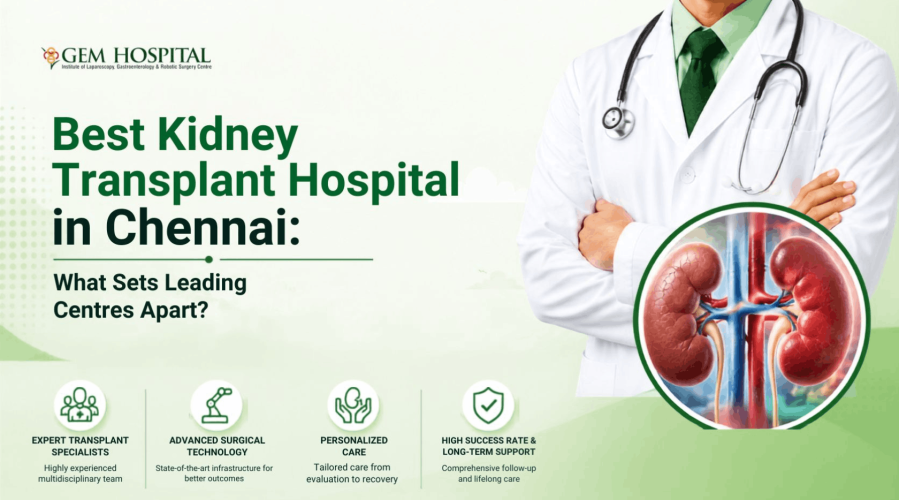
When the kidneys fail, the body no longer can get rid of waste, balance fluids and regulate blood pressureLife without functioning kidneys is possible but it means being tethered to a dialysis machine three times a week, every week, for the rest of your life. A kidney transplant changes that equation completely. It offers the possibility of a near-normal life: working, travelling, being present for family without the dialysis schedule defining every week.
But here's the difficult reality: not all kidney transplant centres are equal. The difference between a centre that is merely equipped to perform transplants and the best kidney transplant hospital in Chennai is measured in outcomes in complication rates, in graft survival, in the quality of follow-up care, and ultimately in the life a patient gets to live after surgery.
This guide will help you understand kidney failure and transplantation, what genuinely sets top centres apart, and how to make the most informed decision for yourself or your loved one.
Understanding Kidney Failure: When Transplant Becomes the Answer
Chronic kidney disease (CKD) progresses through five stages, measured by the glomerular filtration rate (GFR) which reflects how efficiently the kidneys are filtering blood. Most patients do not notice symptoms until Stage 3 or 4. Stage 5 - GFR < 15 ml/min/1.73m2. The kidneys are functioning at less than 15% normal. This is end stage renal disease (ESRD) and the point at which dialysis or a kidney transplant is needed to survive.
Common causes of ESRD include:
- Diabetic nephropathy the leading cause in India; years of uncontrolled diabetes damage the small blood vessels in the kidney
- Hypertensive nephrosclerosis chronic high blood pressure damages kidney tissue progressively
- Glomerulonephritis inflammation of the kidney's filtering units, caused by immune conditions or infections
- Polycystic kidney disease (PKD) a genetic condition where fluid-filled cysts replace functional kidney tissue
- Lupus nephritis kidney inflammation driven by the autoimmune disease lupus
- Obstructive nephropathy long-standing urinary obstruction (from stones or enlarged prostate) damaging the kidneys
While dialysis keeps patients alive, research consistently shows that kidney transplantation offers significantly better quality of life, longer survival, and lower long-term cost compared to remaining on dialysis permanently. Seeking treatment at the Best Kidney Transplant Hospital in Chennai can help patients access comprehensive transplant care and achieve better long-term outcomes.
Dialysis vs. Transplant: Understanding the Real Difference
This is a conversation most nephrology teams have with their patients early. Both dialysis and transplant keep patients alive, but the lived experience is dramatically different. At the Best Kidney Transplant Hospital in Chennai, patients receive expert guidance to understand the benefits, risks, and long-term impact of each treatment option, helping them make informed decisions about their health.
Dialysis:
- Four or five hours at a time, three or four times a week.
- Fluid and dietary restrictions severe
- common are tiredness, reduced stamina and anaemia
- Cardiovascular risk continues to be significantly elevated
- Post transplant long term survival is significantly lower
After successful kidney transplant:
Dialysis is not needed – the transplanted kidney continuously filters the blood as a normal kidney would
- Most dietary restrictions are removed
- Energy levels often improve considerably within weeks
- Dialysis and Cardiovascular Risk: Dialysis is Less Risky
- Long-term survival rates are much better
- Most patients can return to their work and active life

Transplantation is the treatment of choice for eligible patients with ESRD. The trick is to find the right centre to do it safely and successfully. At GEM Hospital, patients benefit from experienced transplant specialists, advanced surgical expertise, and comprehensive care designed to achieve the best possible outcomes.
What Makes the Best Kidney Transplant Hospitals in Chennai Different?
There are several hospitals in Chennai performing kidney transplants. But there are specific markers that distinguish truly excellent programmes from adequate ones.
1. Transplant Volume and Experience
The single strongest predictor of outcomes is how many transplants a centre performs. High-volume centres have surgical teams that are deeply experienced, protocols that have been refined over hundreds of cases, and exposure to rare and complex complications that lower-volume centres rarely see.
2. A Complete Transplant Nephrology Programme
The surgeon performs the transplant, but the nephrologist manages the patient for life. The best centres have dedicated transplant nephrologists specialists in post-transplant immunosuppression management, rejection episodes, infection surveillance, and long-term graft preservation. This is the backbone of long-term transplant success.
3. Comprehensive Living Donor Program
The vast majority of kidney transplants performed in India are living donor transplants, from a compatible family member or an emotionally related person.A strong living donor programme means thorough donor evaluation (ensuring the donor's remaining kidney function is protected for life), paired exchange programmes (kidney swap programmes for ABO-incompatible pairs), and excellent outcomes for donors.
4. ABO-Incompatible Transplant Capability
When a willing donor's blood type is incompatible with the recipient's, ABO-incompatible (ABOi) transplantation using specialised desensitisation protocols makes transplantation possible where it otherwise couldn't happen. This requires specific expertise, and not all centres offer it. At the best hospitals, ABOi transplants are performed routinely with very good outcomes.
5. Paired Kidney Exchange Programme
When a patient has a willing but incompatible donor, a kidney exchange where two or more incompatible donor-recipient pairs swap donors can create compatible matches. Leading centres participate in or run formal paired exchange programmes, significantly expanding the pool of transplant opportunities.
6. Dedicated Transplant ICU and Infectious Disease Support
The early post-operative period requires specialised intensive care. A dedicated transplant ICU staffed by intensivists experienced in immunosuppressed patients makes a genuine difference in managing the critical first days. Equally important is access to an infectious disease specialist, since transplant recipients are at elevated risk for opportunistic infections.
7. Long-Term Follow-Up and Patient Education
Post-transplant care is a lifelong commitment, and the best centres structure this carefully. Regular outpatient clinic visits, access to a transplant coordinator who can field questions between appointments, patient education on medication adherence, lifestyle, and warning signs all of this contributes to the graft surviving decades rather than years.
The Kidney Transplant Evaluation Process: Step by Step
Getting to the point of transplant surgery requires a detailed pre-operative evaluation to ensure both the recipient and donor are safe to proceed.
Recipient Evaluation:
- Complete blood count, kidney function, liver function, electrolytes
- Viral serology Hepatitis B, Hepatitis C, HIV, CMV, EBV
- Tissue typing and crossmatch testing
- Cardiac evaluation ECG, echocardiogram, stress test for high-risk patients
- Urological evaluation to ensure the bladder and urinary tract can receive a new kidney
- Imaging ultrasound and sometimes CT of the abdomen and pelvis
- Nutritional and psychological assessment
- Cancer screening (since immunosuppression can reactivate dormant cancers)
Donor Evaluation:
- Full health assessment to confirm the donor can safely live with one kidney
- Kidney function tests, 24-hour urine collection
- CT angiography to assess kidney anatomy and vasculature
- Cardiac and pulmonary assessment
- Psychological evaluation (independent of the recipient team)
- Ethical clearance per HOTTA regulations
The Surgery and What Follows
The Transplant Procedure
A kidney transplant typically takes three to four hours. Unlike many who expect the diseased kidneys to be removed, they are usually left in place unless they are causing active problems. The donated kidney is implanted in the lower abdomen (the iliac fossa), where its blood vessels are connected to the recipient's pelvic blood vessels, and the ureter is connected to the bladder.
In many cases particularly with living donors the new kidney begins producing urine on the operating table. This is a deeply moving moment for the surgical team, and an excellent prognostic sign.
Immediate Post-Operative Period
The recipient spends 24 to 48 hours in the transplant ICU. Kidney function is monitored closely through urine output, creatinine levels, and ultrasound. Immunosuppression is started immediately. The average hospital stay after an uncomplicated transplant is seven to ten days.
The First Year
The first year post-transplant requires the most intensive monitoring. Outpatient visits are frequent weekly initially, then fortnightly, then monthly. Blood tests check creatinine levels (indicating kidney function) and levels of immunosuppression drugs. Any fever, sudden reduction in urine output, or swelling over the transplant site requires urgent evaluation.
Rejection both acute and chronic is the primary threat to graft function. Acute rejection, if caught early, can often be reversed with high-dose steroids or other treatments. Chronic rejection is a slower process, and the goal of long-term management is to delay and minimise it.
Life Beyond the First Year
Most stable patients settle into a pattern of monthly blood tests and quarterly clinic visits. Immunosuppression doses reduce over time. Many recipients return to full-time employment, resume exercise, and live near-normal lives. Dietary restrictions are far less stringent than on dialysis patients can eat most foods in reasonable quantities.
Choosing wisely based on volume, expertise, team depth, and long-term follow-up significantly improves your chances of a successful outcome and a long, functional graft life. Don't let proximity or cost alone drive the decision. Ask the right questions, visit the centre, meet the team, and make an informed choice. Your kidneys or your loved one's deserve the best possible chance.
Frequently Asked Questions
1.How long does a kidney transplant last?
With modern immunosuppression, living donor kidneys function for an average of 15–20 years, and many last longer. Deceased donor kidneys typically last 10–15 years on average. A second transplant is possible if the first graft fails.
2.Who can donate a kidney?
A living donor should be between 18 and 60 years of age, in good general health, free from kidney disease, diabetes, and significant hypertension, and ABO compatible with the recipient (or eligible for ABOi/exchange programmes). First-degree relatives, spouses, and in some cases emotionally related donors (with ethical committee approval) are eligible.
3.Is it safe to live with one kidney?
Yes. Decades of research have shown that as long as healthy people with one kidney live a healthy lifestyle and attend annual follow-ups, they have a normal life expectancy and little impact on long-term health.
4.What medicines are needed after kidney transplant?
Recipients are required to take immunosuppressant medications – typically tacrolimus, mycophenolate and low-dose steroids – for life. They prevent rejection but also make the person more susceptible to infection and some cancers and so require long-term monitoring.
5.Can a person with diabetes get a kidney transplant?
Yes, and in select centers combined kidney and pancreas transplant may even be an option for diabetic patients with kidney failure. A history of diabetes is not an absolute contraindication to transplant candidacy but it should be well-controlled.
Book a consultation with GEM Hospital’s today.