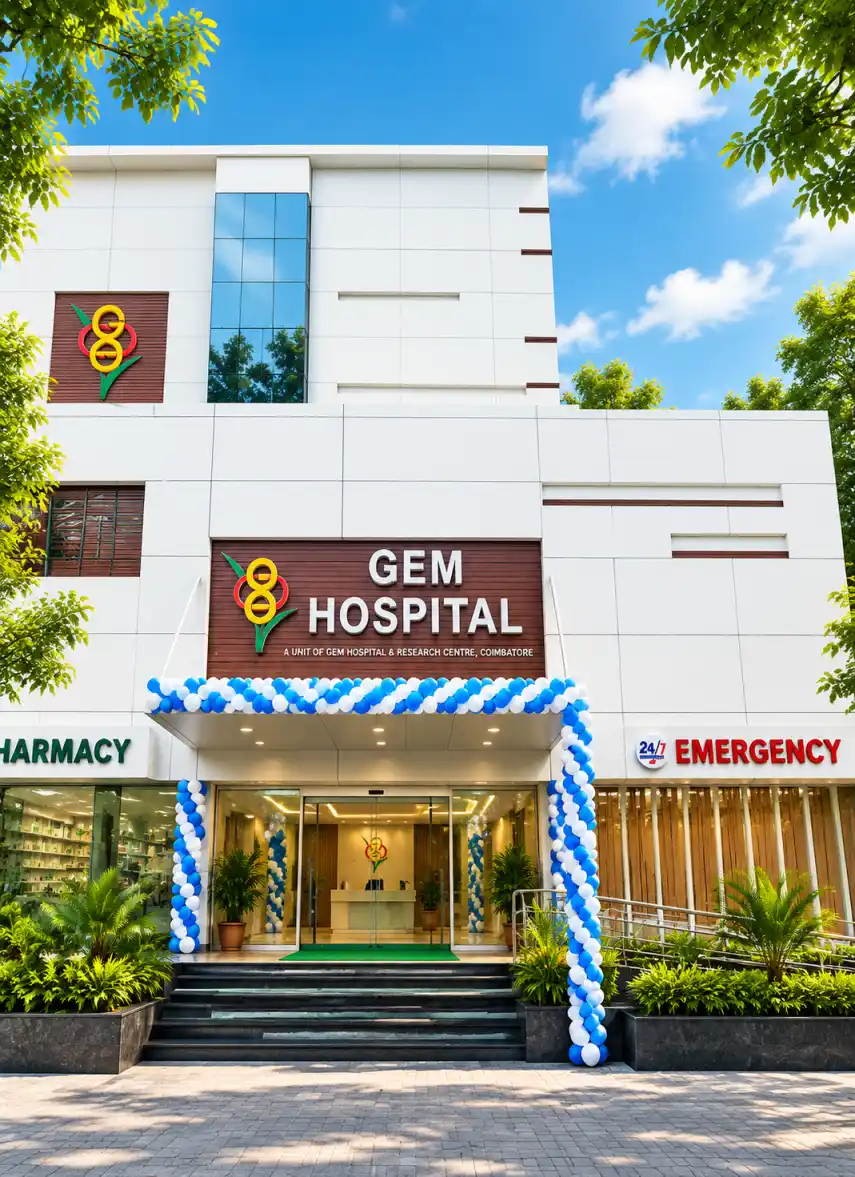

Kidney Stone Treatment in Chennai Modern, Minimally Invasive Care
Kidney Stone Treatment in Chennai Modern, Minimally Invasive Care
Kidney stones are one of the most painful urological conditions a person can suffer from but the good news is that effective Kidney Stone Treatment in Chennai is available right here at GEM Hospital. Our urologic team employs the latest in laser and minimally invasive technologies to treat stones of all sizes with precision, minimal discomfort and quick recovery times. Your first stone or a recurrent problem, we’re here to help.

What is Kidney Stones?
Kidney stones are hard, solid chunks of crystals that develop when the concentration of urine in the kidneys gets too high. They're formed when minerals like calcium, oxalate and uric acid build up and clump together instead of being flushed out of the body. It is very important to know the need for timely Kidney Stone Treatment in Chennai to avoid complications and discomfort.
Stones can be as small as a grain of sand, or as big as a marble, or sometimes even bigger. Kidney Stone Treatment in Chennai Proper Hydration and medical guidance are key in effective Kidney Stone Treatment in Chennai, though smaller stones may pass on their own. In such cases, bigger stones might need expert medical care to get rid of them safely and completely so the patient can recover without discomfort.
Symptoms and Signs of Kidney Stones
- Sharp, sudden cramping pain in the side and back, under the ribs
- Pain that spreads to the lower abdomen and groin
- Pain or a burning sensation when you urinate
- Blood in urine (urine that is pink, red or brown-coloured)
- Frequent urination, or urinating in small amounts
- Cloudy or bad-smelling urine
- Nausea & Vomiting
- Fever and chills (if infection is present – get urgent care)
Causes & Risk Factors
Understanding why stones form is the key to preventing them from coming back. Some common risk factors are:
Dehydration:
The biggest risk factor is not drinking enough water, which concentrates minerals in the urine
High sodium or high protein diet:
Raises calcium and uric acid in urine
Family history:
Kidney stones tend to run in families
Obesity:
Associated with alterations in urine chemistry that promote stone formation
Recurrent urinary tract infections (UTI):
Can cause infection stones (struvite)
Metabolic disorders:
eg hyperparathyroidism, gout
Some medications:
Some calcium supplements and diuretics
How Are Kidney Stones Diagnosed?
At GEM Hospital we help you reach an accurate diagnosis fast, so that you can begin your treatment without delay:
- Ultrasound scan: A quick, radiation-free first test to check for stones in the kidneys or urinary tract
- CT Urogram (non-contrast): Most accurate imaging test – finds even small stones anywhere in the system
- KUB (X-ray): Useful in detection of stones based on calcium
- Urinalysis: Tests for blood, crystals, infection or pH imbalance
- 24-hour urine collection: Measures levels of minerals to help determine composition of stones and risk for recurrence
- Blood tests: calcium, uric acid, phosphate, kidney function
Treatment Options – Today's Kidney Stone Care
GEM Hospital provides the entire range of contemporary Kidney Stone Treatment in Chennai, tailored to the size, location, and type of the stone:
Conservative management (small stones)
Stones less than 5 mm often pass spontaneously with increased fluid intake, pain relief medication, and alpha-blockers to relax the ureter. We'll track your progress and make adaptations as needed.
ESWL – Extracorporeal Shock Wave Lithotripsy
A completely non-invasive technique where focused sound waves break the stone into fine fragments from outside the body. These pass naturally in urine over the following days. Ideal for stones between 5–15 mm in the kidney.
Laser lithotripsy (URSL / Flexible URS)
A thin, flexible ureteroscope is passed through the urinary tract – no cuts required. Once the stone is located, laser energy precisely breaks it into dust-like particles that wash away. This is one of the most effective and patient-friendly approaches available, with same-day discharge in most cases.
RIRS – Retrograde Intrarenal Surgery
For stones inside the kidney that are harder to reach, a flexible scope is passed all the way into the kidney to locate and laser the stone. It's highly effective for complex or multiple stones without any external incision.
PCNL – Percutaneous Nephrolithotomy
For very large or complex stones (over 2 cm) that cannot be treated with shock waves or a scope, PCNL involves a small incision in the back through which a specialised instrument breaks and removes the stone directly from the kidney.
Open or robotic-assisted surgery
Rarely needed today, but available for extremely complex cases or when other treatments have not been effective.
What Makes GEM Hospital The Best Kidney Stone Hospital In Chennai?
Latest laser technology:
Advanced holmium laser systems for dust-free and precise stone fragmentation
Experienced team of urology experts:
Specialists with expertise in all stone sizes and locations
Day care procedures:
Laser treatment usually allows discharge on the same day
Stone analysis detailed:
We analyze the composition of the stone to build a prevention plan and reduce recurrence
Patient education:
We give you diet and hydration recommendations based on your stone type to help prevent future episodes
End-to-end service:
From first consultation to post-treatment follow-up – all in one trusted place
Benefits of Early Treatment of Kidney Stones
Here are some real benefits of Kidney Stone Treatment in Chennai without waiting and hoping the pain will go away:
- Stops the stone from getting bigger and harder to treat
- Lowers risk of urinary tract infection
- Prevents long term kidney damage from prolonged obstruction
- The processing of smaller stones is done with simpler, faster procedures
- Early diagnosis reveals correctable metabolic causes and prevents further stones
Frequently Asked Questions
You should seek urgent medical attention if kidney stone pain becomes severe or impossible to manage. Other warning signs include fever, chills, blood in the urine or an inability to urinate. These symptoms may indicate urinary obstruction or a kidney infection requiring prompt treatment.
The most common symptom is severe, cramping pain in the side, back or lower abdomen. Other signs include painful urination, blood in the urine, nausea and frequent urination. Fever accompanying these symptoms may indicate an infection that needs immediate medical attention.
Treatment depends on the size and location of the stone. Smaller stones may pass naturally with adequate fluids and prescribed medications. Larger stones may require extracorporeal shock wave lithotripsy (ESWL), laser lithotripsy or percutaneous nephrolithotomy (PCNL). Traditional open surgery is rarely necessary.
GEM Hospital describes laser ureteroscopy, including URSL and RIRS, as an effective, minimally invasive option for many patients. The procedure can target stones precisely, and many patients are discharged on the same day. However, the most suitable treatment depends on the stone's size, location and the urologist's assessment.
According to the webpage, many patients return to normal activities within approximately 2–5 days. Laser procedures often allow discharge on the day of treatment or the following day. Patients undergoing PCNL may require a hospital stay of 2–3 days, followed by approximately 1–2 weeks of recovery at home.
The hospital recommends maintaining adequate hydration, commonly describing an intake of 2.5–3 litres of water daily. Reducing dietary salt, animal protein and certain oxalate-rich foods may also help prevent recurrence. Depending on stone composition and individual risk factors, a doctor may prescribe preventive medication.