Looking for liver transplant in Chennai? Learn how to choose an experienced liver transplant surgeon based on expertise, transplant team, technology and care.
Comprehensive Hernia Care in Chennai for Long-Term Relief
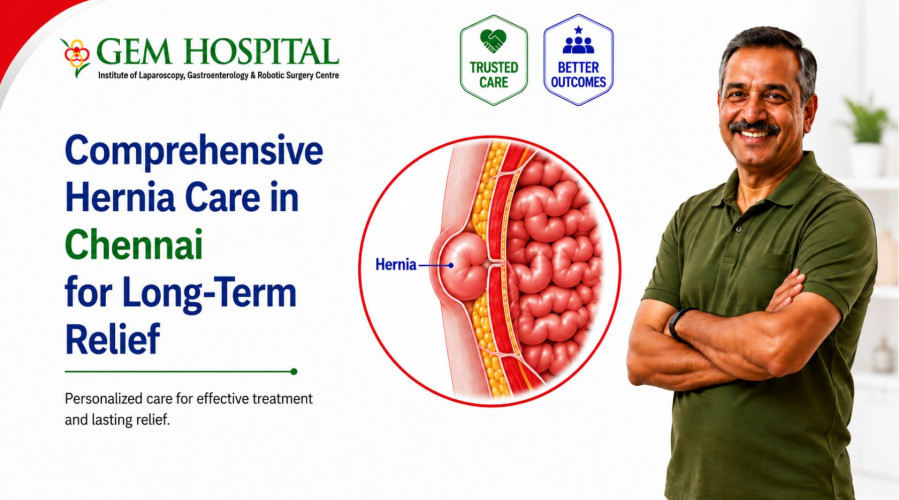
Life with a hernia can be surprisingly restrictive. It may start out as a small painless lump but in the end it can affect work, exercise, sleep and even simple day-to-day activities. But many patients put off seeking help, unsure of what they are suffering from or what treatment involves. Expert hernia treatment solutions in Chennai provide each patient with what they deserve: a clear diagnosis, a personalised treatment plan and comprehensive support from consultation to full recovery.
This article discusses the complete range of hernia care options available in Chennai – designed to provide patients not just relief, but a lasting confidence in their recovery.
What is a Hernia and Why is it Necessary to Treat it?
A hernia is an opening or weakness in the muscular wall of the abdomen through which internal tissue—most commonly a portion of intestine or fatty tissue—protrudes. Unlike a muscle strain, a hernia does not heal on its own. Without treatment, hernias typically enlarge over time and can develop serious complications including incarceration (trapped tissue) or strangulation (loss of blood supply), both of which require urgent surgical intervention. Understanding these risks highlights the importance of seeking Expert Hernia Treatment Solutions in Chennai at the earliest stage.
Common Hernia Types Seen in Chennai
- Inguinal Hernia: Groin hernia, accounting for 70% of all hernias, most common in men
- Umbilical Hernia: Around the navelcommon in infants, obese adults, and post-pregnancy women
- Incisional Hernia: Through the site of a previous surgical incision
- Femoral Hernia: Just below the groin, more common in womenhigher risk of strangulation
- Hiatal Hernia: Stomach sliding through the diaphragmassociated with acid reflux
- Epigastric Hernia: Between the navel and breastbone
- Parastomal Hernia: Adjacent to a colostomy or ileostomy site
Risk Factors
- Family history of hernias
- Chronic constipation or cough
- Obesity and physical inactivity
- Previous abdominal surgery
- Connective tissue disorders
Recognising the Signs
A comprehensive hernia assessment begins with recognising symptoms. While some hernias present as obvious bulges, others are subtler:
- Visible or palpable bulge in the abdomen, groin, or navel—may disappear when lying flat
- A dragging or heavy sensation in the lower abdomen or groin
- Pain or discomfort when bending, coughing, or exercising
- Swelling or tenderness around the testes
- Burning or aching at the bulge site
- Symptoms of acid reflux, belching, or difficulty swallowing (hiatal hernia)
Do not ignore these symptoms. The sooner a specialist can assess you, the less risk of complications, and the more options for less invasive treatments. Seeking Expert Hernia Treatment Solutions in Chennai early can help ensure timely diagnosis and access to the most appropriate treatment options.
Diagnostic Evaluation
Expert hernia care starts with a comprehensive, layered diagnostic approach:
Clinical Evaluation
A hernia can often be diagnosed by physical examination alone by an experienced surgeon. The patient may be asked to stand, cough, or strain to make the hernia more prominent. The assessment includes type, size and reducibility of hernia and signs of complications
Imaging Studies
- Ultrasound: First line imaging, best for inguinal, femoral and umbilical hernias. Readily available and non-invasive.
- Abdomen and Pelvis CT Scan Complex, recurrent or large hernias: detailed cross-sectional anatomy Crucial for surgery planning.
- MRI: Good for occult (hidden) hernias that are not seen on ultrasound.
- Upper GI Series / Endoscopy – Hiatus hernia or concern for gastro-oesophageal reflux.
Preoperative Assessment
Patients are subject to a structured pre-operative assessment prior to surgery, including blood tests, ECG, anaesthetic assessment and optimisation of any medical conditions such as diabetes, hypertension or chronic lung disease.
Chennai Hernia Treatment Expert Solutions – All Kinds Of Care
Non-Surgical Treatments
A supportive hernia truss or belt may provide symptomatic relief for patients who are not good candidates for surgery due to age, frailty or significant medical comorbidities. This is not, however, a curative option, and is generally not recommended for long-term management in patients who are surgical candidates.
Laparoscopic Hernia Repair
The cornerstone of modern hernia treatment, laparoscopic repair is the preferred approach for most hernia types. Performed through 3 small incisions, it allows the surgeon to visualise and repair the defect internally using mesh reinforcement. This technique is associated with:
Significantly lower post-operative pain scores
- Hospital stay of 24 hours or less
- Return to light activity within 3–5 days
- Lower recurrence rate compared to suture-only repair
- Better outcomes for bilateral and recurrent hernias
- Robotic Hernia Repair
For complex abdominal wall reconstructions, parastomal hernias, or cases requiring fine dissection near critical structures, robotic-assisted surgery provides exceptional precision. The surgeon operates via a console with enhanced 3D visualisation and articulated instruments that replicate the movements of the human handwith the added stability of eliminating physiological tremor.
Open Hernia Repair with Mesh
Open surgery remains the gold standard for very large hernias, emergency strangulation repairs, or cases where laparoscopy is not feasible. Modern lightweight mesh materials have dramatically reduced recurrence rates even in open repairs.
Pediatric Hernia Care

Inguinal and umbilical hernias in children require specialist pediatric surgical expertise. Most childhood hernias are repaired with simple suture closure without mesh, using minimally invasive techniques adapted for small body size.
Long-term results powered by innovative technologies
- Biologic and Hybrid Mesh: Minimizes foreign body reaction and is ideal for contaminated or infected fields.
- 3D Mesh Systems: Improved durability from natural anatomy body conforming.
- Fluorescence-Guided Surgery: Allows real-time evaluation of the blood supply of the tissue being excised.
- Intraoperative Ultrasound It confirms the complete reduction of the hernia and the placement of the mesh.
- Component Separation: An advanced method for large, complex ventral hernias utilizing muscle advancement to close the defect without undue tension.
The Long-Term View – Why Holistic Care is Important
Repair of hernias is best when part of a comprehensive plan of care addressing root causes.Patients at the best surgical centres in Chennai receive:
Pre-operative optimisation: Weight management, smoking cessation and chronic cough management reduce risk of recurrence
Right mesh choice Individualized according to the type and location of hernia and patient characteristics
Core rehabilitation: Physiotherapy to strengthen abdominal muscles and reduce the risk of a re-herniation in the long run
Follow-up imaging: If necessary for large or complex repairs
Lifestyle tips: Dietary advice, exercise instructions and occupational therapy of manual workers
Aftercare and Recovery – What to Expect
Immediate postoperative period
Patients can usually get out of bed within hours after laparoscopic surgery.Pain is well-controlled with oral medication. Most patients are discharged the following morning with clear written instructions.
First Two Weeks
Light activity such as walking is encouraged from day one. Avoid lifting more than 5 kg. Some swelling and bruising around the repair site is normal and resolves over 1–2 weeks.
Weeks 3-6.
Slowly return to exercise and work activities as recommended by the surgeon. Full exercise and manual labour is usually cleared at the 4-6 week follow up appointment.
Why Chennai for expert treatment of hernia
General and Specialist HPB Surgeons: Fellowship trained, board certified hernia specialists in minimally invasive and robotic techniques.
- Full Pre and Post-operative Support: Dietitians, Physiotherapists, Anaesthetists and Nurse Coordinators.
- High-Volume Centres: More surgical experience directly translates into lower complication and recurrence rates.
- Affordable world-class care: Hernia repair in Chennai is a fraction of the cost of equivalent procedures in private hospitals in the UK, USA or Singapore.
- Technology Investment: Latest robotic systems, mesh materials and laparoscopic imaging platforms .
Don’t live with a hernia. Expert Hernia Treatment Solutions in Chennai provide patients with some of the most advanced minimally invasive surgical techniques, performed by experienced specialists dedicated to long-term outcomes.
If you have been putting off treatment, it’s time to get started. One visit to a specialist could be the step that gives you back your comfort, your confidence and your freedom of movement for good. By choosing Expert Hernia Treatment Solutions in Chennai, patients can benefit from advanced care and personalized treatment plans designed for lasting relief.
At GEM Hospital, experienced hernia specialists offer comprehensive evaluation, advanced minimally invasive surgical techniques, and patient-centred care to help patients achieve the best possible outcomes and a faster return to everyday life.
FAQs
1. How do I know what kind of hernia I have?
To confirm the type, size and severity of the hernia, a physical exam and, if necessary, an ultrasound or CT scan will be performed. Your surgeon will discuss the results with you and suggest the best treatment.
2. Can I work out with a hernia?
Walking and other light activity is generally safe. Avoid heavy weight lifting, strenuous core exercises or anything that greatly increases abdominal pressure until you have had surgical repair.
3. What happens if the hernia is left untreated?
Untreated hernias tend to get bigger over time and have an ever-increasing risk of incarceration or strangulation, which are emergencies requiring immediate surgery in less than ideal conditions.
4. How likely is hernia recurrence after repair?
Modern mesh techniques and laproscopic repair have recurrence rates <5% in the hands of experienced centres. Maintaining a healthy weight and avoiding heavy straining also lowers this risk.
5. Do women with hernias have special considerations?
Femoral hernias are more common in women and more likely to become strangulated. Pregnancy plans also need to be considered when selecting mesh and repair technique. The approach will be tailored by your surgeon.
6. Can a hernia be treated without surgery?
There is no proven non-surgical cure for hernias at present. Conservative measures may temporarily control symptoms, but surgical repair is the only definitive treatment.
Book a consultation with GEM Hospital’s today.