Learn about gallbladder stone symptoms, diagnosis, treatment options, surgery and recovery at GEM Hospital, Chennai.
Struggling with Pain or Swelling? Discover Advanced Kidney stone Treatment in Chennai
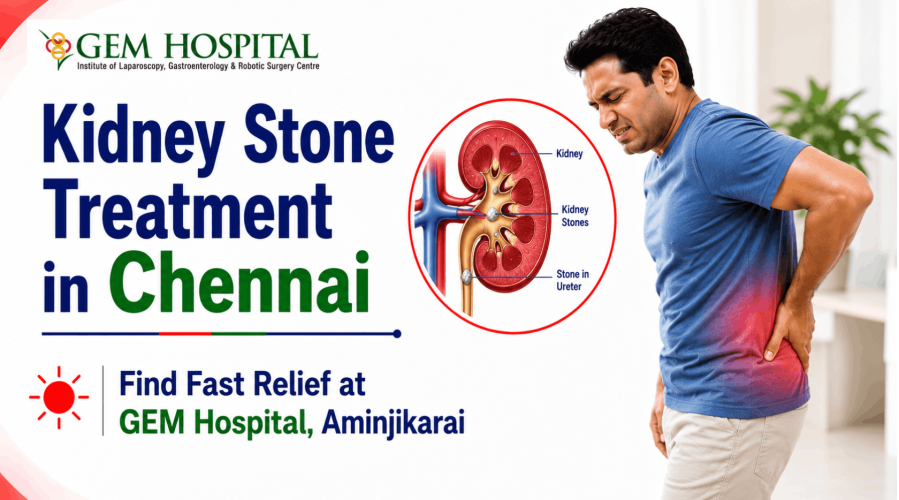
Kidney Stone Treatment in Chennai: Fast, Effective Relief at GEM Hospital, Aminjikarai
If you have experienced a kidney stone attack, you will understand immediately when patients describe it as some of the worst pain of their lives. It comes without warning a savage, gripping pain in the lower back or side that can reduce you to the floor in minutes. And if you live in Chennai, the hot climate and the tendency to stay dehydrated put you at considerably higher risk than you might think. Kidney Stone Treatment in Chennai has become highly advanced, and at GEM Hospital, Aminjikarai, we can treat virtually any stone from a 4mm fragment that needs a gentle push to a 3cm staghorn stone requiring precision surgery with minimally invasive techniques and minimal recovery time.
What Are Kidney Stones?
Kidney stones form when certain minerals in the urine calcium, oxalate, uric acid, or phosphate become too concentrated and begin to crystallise. Over time these crystals cluster into hard deposits that range from a grain of sand to a golf ball in size. Small stones often pass on their own with sufficient hydration. Larger ones lodge in the ureter or kidney, block urine flow, cause severe pain, and often trigger infection. Chennai's climate is a significant factor when you sweat heavily and don't replace fluids adequately, urine becomes dangerously concentrated.
Who Gets Kidney Stones? Common Causes and Risk Factors
Kidney stones are far more common in South India than most people realise. Here are the main risk factors:
- Chronic dehydration the single most preventable cause, especially in Chennai's summer months
- High-salt diet sodium drives calcium into the urine, increasing stone formation risk
- Excessive consumption of oxalate-rich foods spinach, tomatoes, beets, and certain nuts
- High animal protein diet red meat and poultry raise uric acid levels
- Sedentary lifestyle and obesity, which alter urinary metabolism
- Family history if a parent or sibling has had stones, your risk is significantly higher
- Prior kidney stone episodes without lifestyle changes, recurrence rates exceed 50% within 5 years
- Medical conditions such as gout, hyperparathyroidism, or recurrent urinary tract infections

Symptoms That Need Attention
Kidney stones can be completely silent for months but once they start moving, the symptoms leave little doubt:
- Severe, sudden pain in the back or flank, below the ribs often described as coming in waves
- Pain that radiates from the back around to the lower abdomen and groin
- Burning sensation or pain while urinating
- Pink, red, or brown urine blood in the urine is a hallmark sign
- Nausea and vomiting during a pain episode
- Frequent urination or feeling unable to fully empty the bladder
- Fever and chills with back pain this signals an infected stone and requires urgent care
Why Prompt Treatment Prevents Serious Kidney Damage
A stone blocking the ureter creates a backpressure that damages kidney tissue progressively. Repeated episodes of obstruction cause cumulative and permanent kidney damage. More dangerously, a blocked, infected kidney a condition called pyonephrosis can become life-threatening within hours. The reassuring reality is that most stones treated promptly with modern minimally invasive techniques leave no lasting kidney damage whatsoever. The problem is not the stone itself, it is the delay in treating it. Kidney Stone Treatment in Chennai
Kidney Stone Treatment at GEM Hospital, Aminjikarai
Our urology team at GEM Hospital offers the complete spectrum of modern stone treatments, matched to your stone's size, location, and type:
Medical Management for stones under 5mm; hydration, medication, and watchful waiting with regular imaging
- ESWL (Shock Wave Lithotripsy) non-invasive sound waves break stones into passable fragments without any incision
- URS with Laser Lithotripsy a fine scope passed through the urinary tract locates and laser-fragments the stone precisely
- PCNL (Percutaneous Nephrolithotomy) for large or complex stones; a small back incision allows direct stone removal
- Mini-PCNL and Ultra-Mini PCNL less invasive versions for medium stones with faster recovery
- Metabolic Evaluation post-treatment testing to identify why stones formed and how to prevent recurrence
Why Choose GEM Hospital, Aminjikarai, Chennai?
- Full spectrum urology department from medical management to robotic-assisted surgery
- State-of-the-art lithotripsy machines, laser systems, and flexible ureteroscopes
- Experienced urologists with specialist training in endourology and stone disease
- In-house imaging and pathology for rapid, accurate diagnosis
- Personalised dietary and prevention counselling after every stone treatment
- Central Aminjikarai location easily reached from across Chennai
- Lifestyle Tips to Prevent Kidney Stones in Chennai
- Drink 3–4 litres of water daily increase this during Chennai's summer months
- Reduce salt intake meaningfully sodium is a major driver of calcium stones
- Limit spinach, beets, and other high-oxalate foods if you have had calcium oxalate stones
- Cut back on red meat and poultry they elevate urinary uric acid levels
- Exercise regularly physical activity reduces urinary calcium excretion
- Follow the personalised dietary plan given by your GEM Hospital urologist after treatment
When to See a Doctor and When to Go Straight to Emergency
See a doctor promptly for blood in the urine, pain during urination, or any episode of back pain that you suspect is renal. Go directly to emergency if you have severe flank pain with fever above 38.5°C, persistent vomiting, or are unable to urinate at all. These are signs of an obstructed, infected kidney a condition that requires immediate intervention.
Frequently Asked Questions
1.What is the best treatment for kidney stones?
The best treatment depends on stone size , location and composition . Small stones treated conservatively with hydration and medication. For the bigger stones we use ESWL, ureteroscopy with laser or PCNL. At GEM Hospital, our urologists select the least invasive, most effective approach after a thorough evaluation.
2.How do I know if my kidney stone needs emergency treatment?
If back or flank pain is accompanied by fever, chills, and vomiting or if you cannot urinate seek emergency care immediately. An obstructed, infected kidney is a life-threatening urological emergency. Do not wait for a regular appointment.
3.Why do kidney stones come back even after treatment?
Without correction of underlying dietary habits and metabolic factors, as many as 50% of patients will have recurrence of kidney stones within 5 years. At GEM Hospital, every patient with stones undergoes a metabolic evaluation and a customized prevention program to reduce the risk of recurrence.
4.How long does recovery from kidney stone surgery take?
Recovery depends on procedure. After ureteroscopy, most patients go home within 24 hours and return to normal activity in 2–3 days. After PCNL, hospital stay is 3–5 days with full recovery in 1–2 weeks. Your surgeon will tell you about activity limitations and follow-up care.
5.When is it time to seek treatment instead of waiting for the stone to pass?
Stones <5mm usually pass within 2-4 weeks with good hydration. However, if the pain is severe, not controllable and/or the stone is 6mm or larger and/or there is fever or infection, medical attention should not be delayed. The specialist at the GEM Hospital will advise you after seeing the images and taking your clinical condition into account.
Book Your Kidney Stone Checkup at GEM Hospital, Aminjikarai, Chennai Today & Avoid Another Stone Attack!
Book a consultation with GEM Hospital’s today.